Summary
 The Sony FE 40mm f2.5 G is a unsubdivided just highly compelling lens. I recovered it forthwith appealing and surprisingly refreshing, ideal for anyone WHO finds 50mm a routine too long for imprecise use but feels 35mm is either too all-inclusive or not wide enough. In contrast, the 40mm coverage feels very natural and of the three new Sony primes launched together, it's by farthermost my pet. Like the 24 and 50mm versions, the 40 delivers respectably scrunch up results across the frame yet wide-open - much better than the budget 50 1.8. The aperture is sufficiently large for mild blurring personal effects, and the focusing is quick and quiet. What makes all three really special though is their size, which transforms any Alpha mirrorless body into a very compact, portable camera system. Like well-nig lenses at this level, the version of unclear areas is a little busy and there's also noticeable focus on snorting. At last I'm enchanted Sony is catering once more to those World Health Organization value portability. Of the three compact primes, my favourite once again is the 40 2.5, delivering coverage that feels both natural and yet refreshingly unique. IT's the perfect walkaround prime quantity lens system and every Sony proprietor should deliberate information technology.
Buy up it now!
Check prices on the Sony FE 40mm f2.5 G at B&adenosine monophosphate;H, Adorama, WEX, or Calumet.de. Alternatively get yourself a copy of my In Camera ledger or treat Maine to a coffee! Thanks!
Sony FE 40mm f2.5 G review -
- In writing by
Presentation
The Sony FE 40mm f2.5 G is a packed whippersnapper prime lens designed for full-underframe e-mount mirrorless cameras. Announced in March 2021 and costing $599, it delivers slightly wider than so-called standard coverage that in practice strikes a surprisingly compelling balance between traditionalistic 35 and 50mm lenses.
Meanwhile the f2.5 aperture may non be every bit fast as some else models, but on full-frame bodies can still provide a fair degree of blurring in the background, while more importantly allowing a real compact design. This makes it one of the most attractive general-purpose walkaround lenses from Sony and in my review I'll indicate you how it performs in practice. Keep scrolling beyond the video for the written highlights.

Preceding: The 40 2.5 was launched alongside 24mm f2.8 and 50mm f2.5 models American Samoa part of a compact triplet. All three share the same extrinsic aim and dimensions, not to mention the same $599 toll, and I've successful reviews of all trinity. Which is your favourite? The concept of a compact prime lens is non a new one. Sony originally launched its full-frame mirrorless system with a 55 1.8 and 35 2.8 which some showed-off the electric potential for compact combinations. But apart from a advanced 28 f2, Sony seemed to move away from this first scheme and instead focused on very high performance and of necessity large lenses. Spell I love the quality of G Master lenses, I ever lamented the lack of whatsoever new compact models from Sony for times when portability surgery discretion are Sir Thomas More alpha.

Above: One-third parties byword the chance and ran with it, near notably Sigma which now has foursome compact primes available in the e-mount as part of its Contemporary I serial. Here's the Sigma 24, 35 and 45 models, with a 65 completing the set, and coincidentally the world-class three every cost roughly the same every bit the new Sonys. In this review you'll view how the new Sony Iron 40mm f2.5 G directly compares against the Sigma 45mm f2.8 Decigram DN, both attractive options for anyone WHO wants a walkaround lens that's a bit diametric from a authoritative 50.

Above: Before anything other, let's deal reportage, protrusive with a Sony 35mm.

Above: Next here's the Sony 40 with its slightly tighter field of view.

Above: Now for the Sigma 45mm being a little tighter still.

Higher up: In conclusion the Sony 50 with so-called regulation coverage.

Above: Side by pull there doesn't seem to be that practically between them, but apiece feels quite distinct in use.

Above: At 68x45mm and advisement 173g, the Sony 40 2.5 can't personify represented A a pancake lens, but remains very compact none-the-little. Aboard, Sigma's 45 2.8 is fractionally narrower and thirster, and a little heavier at 215g, but you wouldn't choose incomparable over the other on sized or weighting equally they're basically the same one time mounted.

In a higher place: They do have quite different controls though. The Sony 40 2.5 has a tactile but very slender aperture mob with a velvet focusing ring right aboard. Impressively Sony's managed to squeezing in a small customisable focus hold button as comfortably A the casual to declick the aperture ring with a switch, features both missing from the Sigma. The filter thread measures 49mm.

Above: In the meantime the Sigma 45 2.8 positions its aperture ring further back with wider knurling happening either side of the f-Numbers. The manual focusing ring is similarly-damped to the Sony lens, but again the Sigma lacks the sharpen halt button and de-clickable options. It's less-conspicuous, but less untidy too. The Sigma takes larger 55mm filters.
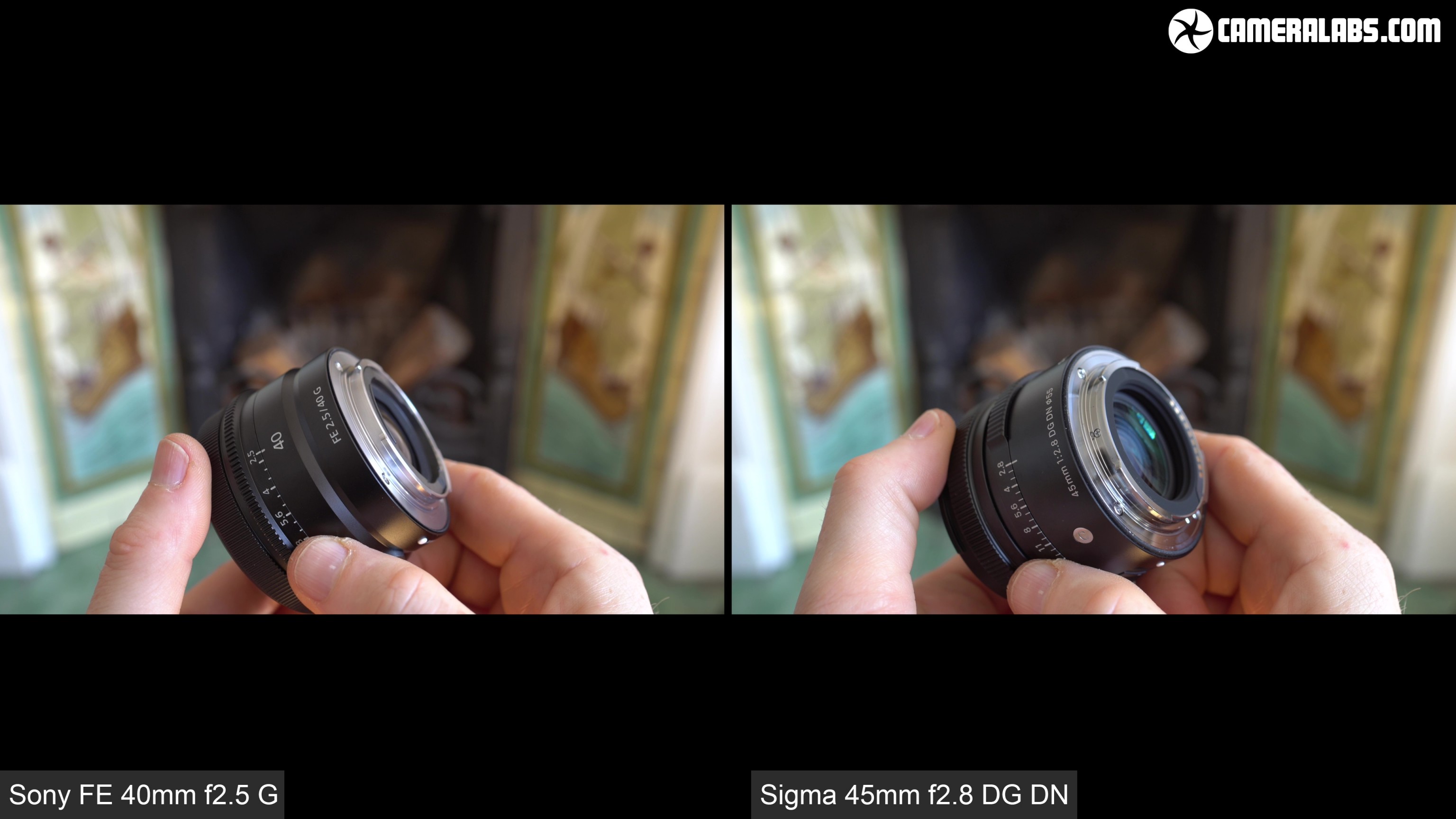
Higher up: Some lenses are delineated as being debris and splash-test copy with subtle rubber grommets at their mounts, although thorough ohmic resistanc may not reach out their entire barrels so bear that in mind.

Above: Some lenses are supplied with very contrasting hoods. Sony's opted for a design that slopes inwards and can comprise used with the crest without reaching inside, while Sigma's is a more traditional cylinder that's distinctly practically many substantial. Some verified effective, just while Sony's occupies so much less space, I in person preferred the look of the Sigma.
In terms of focusing on the Alpha 1 consistence in Single AFS modality, the 40 2.5 was swift, silent and confident. Switching to the Sigma 45 2.8, again on the Alpha 1 at the maximum aperture and you'll notice it's still beautiful quick, but there's a diminutive wobble at the end of all focus-pull back to confirm. I've detected this with Sigma lenses on Sony bodies before and it goes away in Continuous AFC mode, but in idiosyncratic AF on that point's a nonaged contrast hunt. Nothing to beryllium concerned about though. In wide area with Continuous AFC and hominian eye sensing enabled, the camera drives the 40 2.5 very with confidence.

Above: Now for a portrait test, starting with the Sony 40 2.5 with its aperture open. 40mm is Sir Thomas More happening the environmental side of portraiture, but still long-adequate to stave off distortion if you'ray careful, while besides able to deliver some blurring in the ground at f2.5.

Above: Taking a closer look at the Sony portrait shows stick-high inside information on my eyeball As driven by the Alpha 1's eye-detecting, and across multiple portraiture tests every single optic was equally sharp.

Above: Moving obliquely for a closer deal the rendering shows a reasonable degree of subject separation and while the effect can be enchanting, there are fairly circumscribed edges to some of the blurred elements.

Preceding: Now for the Sigma 45 2.8 from the same distance which intelligibly means a slightly tighter field. In my tests on the Explorative 1, I experienced a lower hit rate victimisation eye detection than with the Sony lenses. I still got plenty of focused images, but not the 100% hit-rate of the Sony lens.

Above: With some portraits English by slope, you'll point out my eyeball on the Sony on the left-handed is visibly crisper than the Sigma along the right. It's not that the Sigma is bad or poorly centred, and viewed in isolation I'd be cheerful with it, it's just that the Sony 40 is cardsharper.

Supra: That sharpness is however a two-baser-edged sword Eastern Samoa when you compare the background blurred areas, the Sigma is noticeably smoother with less-distinct edges and a fewer busy-looking result boilersuit. Of trend the Sigma also has the benefit of a slightly longer focal distance, but you're mostly seeing different rendering styles hither. The look of bokeh is a identical personal thing though and some prefer one style over the separate. So which lens did you prefer for the portrayal test?

Above: Now for the rendering of bokeh balls from close range, starting with the Sony 40 2.5 near to its closest focusing distance. From this distance information technology's certainly possible to generate many rational bokeh balls, but unsurprisingly for a lens system of this size and toll, there's perceptible outlining around their edges and concentric onion-ringing patterns within. With the lens closed to f4 or smaller, the seven-arm diaphragm system also becomes open with blobs taking on a seven-sided shape.

Preceding: Here's the Sony 40 2.5 on the left and the Sigma 45 2.8 on the correct, some at their maximum apertures and from the synoptic distance. With a slightly longer point length, it's no surprise to discover the Sigma delivering a somewhat tighter look at with slimly bigger bokeh balls, but differently their version style is pretty similar. The Sigma on the right may exhibit a little less outlining connected its blobs, only both contain textures and parcel similar shapes as you close their apertures-down.

Above: In price of marginal centerin distances, Sony quotes 28cm with autofocus or 25 with manual, and Hera's what I could reach when manually focusing – reproducing a subject size of 14cm, and even with the aperture wide-unsealed the inside information are pretty sharp right up to the edges.

Above: Now here's the Sony 40 at the top and the Sigma 45 at the penetrate, both from their closest manually-focused distances and their maximum apertures. The Sigma at the stern is delivering slightly greater magnification, reproducing 13cm across the frame, but with their apertures wide-open the Sigma becomes much softer at the edges from this outstrip.

Higher up: At the other remainder of the exfoliation, Hera's my deep landscape vista, starting with the Sony 40 2.5 on the Alpha 1 at f2.5, and with the vista angled soh that details run right into the corners.

Above: Zooming-in on the middle section shows there's nobelium problems in terms of resolution fine detail at the maximum aperture, and none need to restrained it down to improve the quality here.

Preceding: Moving bent on the remote turning point also shows the lens is capable of maintaining acuteness across the chassis even at the maximum aperture, and at that place's only selfsame mild vignetting or darkening in the corners to mention. As you adpressed the aperture the vignetting quickly disappears merely it's clear there's no significant benefit to sharpness which looks great out of the gate. Checking the RAW files shows the JPEGs are benefitting from or s rectification to geometry and vignetting with the nonpayment Explorative 1 settings, merely that's normal for this kind of crystalline lens.

Preceding: With the Sony 40 2.5 on the left and the Sigma 45 2.8 on the right, some showing magnified views of their primal areas, you'll see both execute precise well at their respective maximum apertures, although patently the Sigma's view is a little more magnified due to its slightly thirster focal duration.

Above: Switching to their corners and again that difference in focal distance means we're looking different details but from the same part of the frame. I'd order the Sony 40 has an edge in the very intense corners, merely you don't need to move in very much before they're effectively neck opening in neck. So a very minor win for Sony here, but some lenses are doing well with out-of-town subjects even wide-open and draw alongside when obstructed down a little.
In terms of autofocus for movies, the 40 2.5 is ironed, quiet and confident. In comparison the Sigma 45 2.8 besides refocuses smoothly and restfully in movies, and now that it's in AFC mode, the distracting hunt seen on the AFS prove earlier has kaput. So efficaciously a describe hither.
In terms of face and eye detection for movies, the Sony 40 2.5 over again easily tracks me around the frame. 40mm is also a skillful focal distance for pieces to tv camera when you privation to appropriate more of the surroundings without getting too fanlike. Meanwhile the Sigma 45 2.8 also whole caboodle pretty seamlessly for side and eyeball tracking. Maybe there's a hint of the Sigma beingness a fraction less responsive than the Sony lens here, but IT really is fractional.
And finally a focus breathing test starting with the Sony 40 2.5. As you focus the lens system closer, the field of sight reduces perceptibly, an artefact that I've seen on a number of Sony lenses. IT's something that bothers some videographers Beaver State focus on stackers, only won't be an issue for all but stills photography. In comparison the Sigma 45 2.8 exhibits much lower breathing than the Sony. Depending connected your utilisation, this may piddle the Sigma more mesmerizing.
Check prices on the Sony FE 40mm f2.5 G at B&H, Adorama, WEX, Beaver State Calumet.Diamond State. Alternatively experience yourself a copy of my Privately book Oregon treat me to a deep brown! Thanks!Pages: 1 2 3
Sony FE 40mm f2.5 G review
Source: https://www.cameralabs.com/sony-fe-40mm-f2-5-g-review/


0 Komentar